
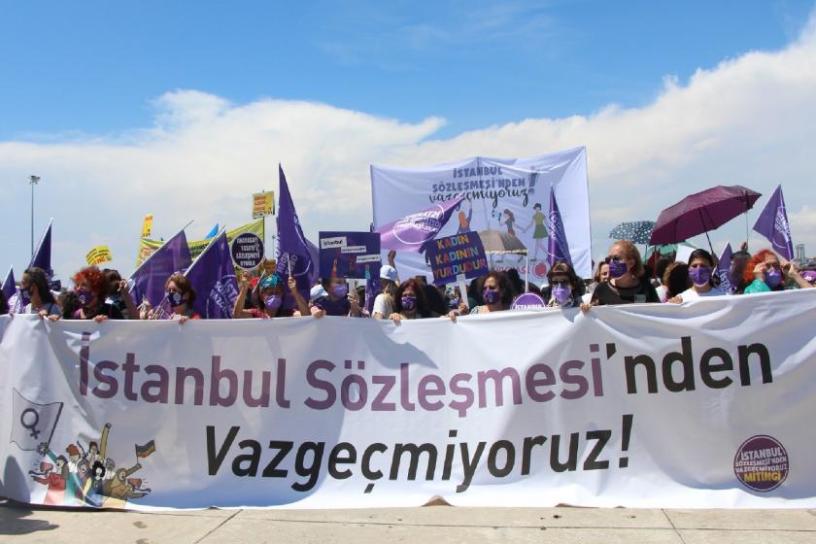
In the first piece of this two-part series, I explained the Istanbul Convention, its importance and Turkey’s withdrawal process , and briefly touched upon why the Istanbul Convention is one of the main targets of the global anti-gender movement.
The Rise of Masculinist Backlash against the Convention
Turkey was among the first countries to sign the Convention in 2011, which entered into force in 2014. As in the rest of Europe, women’s rights organisations in Turkey celebrated the signing of the Convention as a milestone in protecting all women and girls from violence. In Turkey, the women’s movement took its efforts one step further and enacted Law No. 6284 on the Protection of the Family and Prevention of Violence against Women[5] to protect women, children, family members and victims of stalking and those who are subjected to violence or at risk of being subjected to violence. Both pieces of legislation were the fruits of consistent and admirable efforts by women’s rights groups and their negotiations with governments.*
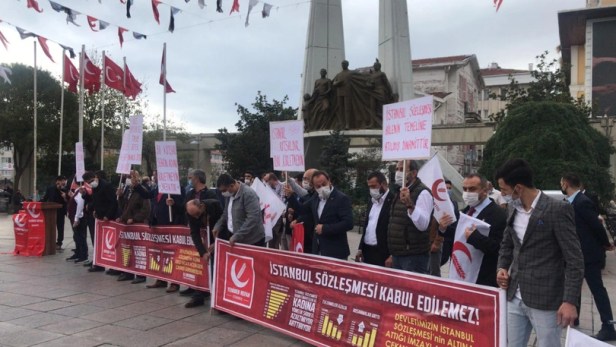
However, the Convention has faced an unprecedented backlash in Turkey and elsewhere in Europe, mainly because it defines “gender” as a social construction and includes LGBTI people and migrants. Conservative politicians and groups claim that the Convention threatens the “traditional” family structure, promotes homosexuality and so-called “gender ideology”, and erodes “national values”. These were the widespread claims of the attacks on the Convention in Turkey.
Media outlets known for being close to the AKP government and even for setting the government’s agenda launched a smear campaign against the Istanbul Convention, which they described as a “project of destruction“, “terrible danger” or “poisonous fruit“. In the ruling sector, for example, Chief Public Auditor Şeref Malkoç said of the Istanbul Convention in 2019, “When spouses quarrel, the wife calls the police station and files a complaint, resulting in the husband getting suspended from the family house. This fuels anger and violence against women. We passed legislation so that the spouses should be separated instead of reconciling.” In August 2020, President Erdoğa targeted the Istanbul Convention, saying, “No regulation that lay dynamite under family is humane and legitimate.” Again, during this period, President Erdoğa stated that the Istanbul Convention was not legitimate. In another meeting held during this period, he said, “If the people want it, we will abolish it.” However, according to the “Turkey’s Pulse” survey conducted by Metropoll Strategic and Social Research in July 2020, only 17% of respondents approved Turkey’s withdrawal from the Convention, while 63.9% disapproved. As a result of the women’s groups’ resistance, the rate of those who wanted to withdraw from the Istanbul Convention dropped to 7%. These surveys clearly show us that the wishes, needs and opinions of the “public” were ignored, and a biased motive was acted upon on the way to the decision to terminate the Istanbul Convention.
As for the grassroots, especially since 2016, we more frequently encounter groups of mostly conservative or Islamist men”victimised” by women’s so-called “excessive” legal rights. These groups have been systematically attacking the legal regulations (Istanbul Convention, Lanzarote Convention, Law No. 6284) that are used to effectively combat violence against women, domestic violence, early marriages, sexual abuse of children, especially women’s legal rights in marriage and divorce, primarily through the pro-government, mainstream media, and at the centre of their objections is the claim that these legal regulations harm gender equality by creating male victimisation and pose a threat to the family.
Since the 80s, due to neoliberal policies in Turkey, the state has withdrawn itself from welfare services such as care, education and health care and placed the task of meeting these needs on the family, that is, on women. During the AKP period, this tendency gained tremendous momentum. When the state stopped providing these services, neoconservative discourses, including familism, nationalism, religion or tradition, were adopted as a “moral compass” to fill the functional gap in its definition (Acar & Altunok, 2015). For these reasons, this “traditional family” imaginary, which defines men as the head of the family and women as wives, mothers and caregivers, is a valuable tool for the AKP government to maintain its “one man” rule. It also absolutises male dominance in society by handing over the “head of the family” to men, one of the pillars of male privilege in society. In this respect, it is possible to say that these attacks, which suppress both from the top and the bottom against legal regulations that recognise women as individuals and bring solutions and sanctions for an equal, free and non-violent life to protect and maintain the “sacred family”, are a patriarchal alliance united in the goal of absolute male domination.
As a result of the voices of conservative, far-right and Islamist groups, which, although small in number, have become louder and louder, and the patriarchal cooperation of the political authorities with them, the Istanbul Convention was annulled by the Presidential Decree on March 20, 2021. In the first 12 hours after the annulment decision was announced, men killed six women. Cemal Metin Avcı, who brutally murdered Pınar Gültekin, said during his testimony at the trial that “it was good that the Istanbul Convention was annulled.” These two examples alone clearly show the vital importance of the Istanbul Convention in gender equality, prevention and prosecution of violence against women and femicides, and protection and defence of women and girls.
The Istanbul Convention was signed in 2011, when the AKP government was in power, and was abrogated in 2021, also when the AKP government was in power. This change also reveals how the authoritarian and oppressive “new Turkey” regime, which has become more entrenched, especially after 2015 and under the conditions of the State of Emergency, has changed its attitude towards women’s and LGBTI rights, violence against women and gender equality.
Women’s and LGBTI+ Groups’ Strategies to Counter the Backlash
The second anniversary of the overnight abrogation of the Istanbul Convention is approaching. Just as the male supremacist, familialist, and anti-gender equality movement has a global dimension, there is a strong global resistance against these attempts.
Throughout this entire process, women’s and LGBTI organisations have taken a targeted and determined stance, tirelessly fighting for the reversal of this decision. They organised international meetings with women’s and LGBTI organisations in Europe and worldwide, held meetings with various political actors inside and outside the Parliament, and formed alliances with some of them. Applying to the law for the annulment and stay of execution of the Presidential Decree constituted an essential pillar of the struggle. Throughout this process, all women’s organisations in Turkey acted as a single body, both based on individual organisations and within the Women’s Platform for Equality (EŞİK), which consists of more than 300 women’s organisations, platforms and groups.
The announcement that the Convention would be terminated in March 2021 sparked outrage nationwide. In response to this intense reaction, the government announced they would work on another legislation, namely Ankara Convention, to replace the Istanbul Convention, which would prioritise “national values”. Still, there has not been any progress in this “national-values-friendly” convention, nor has the decision to terminate the Istanbul Convention been reversed.
The Convention, unanimously adopted by the Turkish Grand National Assembly, was terminated in violation of Article 90 of the Constitution of the Republic of Turkey, which states that a presidential decree cannot remove international treaties on fundamental rights and freedoms. Therefore, bar associations and women’s organisations protested the announcement because the way Turkey withdrew from the Istanbul Convention was unconstitutional, and the decision to terminate was null and void.
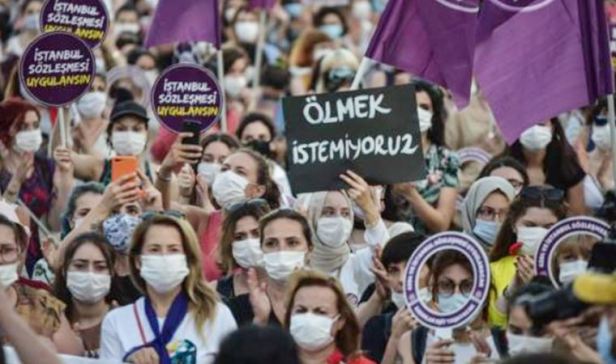
Countless women across Turkey took to the streets amid the pandemic to protest the decision to withdraw from the Istanbul Convention. The government’s reaction to the protests against the Istanbul Convention once again revealed its policy towards women’s rights: Countless women who participated in the protests were detained, fined over 100,000 liras, and prosecuted; refugees who participated in the demonstrations were threatened with deportation.

The Women’s Platform for Equality was a leading actor in the organized struggle against the decision to withdraw from the Convention. On March 23, 2021, on the Presidential Decree on Turkey’s withdrawal from the Istanbul Convention, EŞİK appealed to the Council of Europe with a letter stating that this initiative was against the Turkish legal system and violates the Constitution. Subsequently, on April 1, 2021, 27 member states of the Council of Europe issued a joint statement on Turkey’s decision to withdraw from the Istanbul Convention. The statement read, “It is difficult to understand this decision, which jeopardizes the protection of women’s rights in Turkey and sends a disturbing message to all women and men in Europe and beyond.” The same statement also emphasized that the Istanbul Convention, like all other human rights treaties, guarantees human rights and national measures alone cannot achieve this.
More than 220 lawsuits were filed by women’s organizations, bar associations, professional organizations, trade unions, political parties and real persons to annul the decision to withdraw from the Istanbul Convention. The 10th Chamber of the Council of State rejected the lawsuits with the vote of 3 judges against 2, finding the decision to withdraw “in accordance with the law”. With the call of the EŞİK, the authorization certificates of more than 1000 women lawyers were submitted in some cases. As the trials continued, there were many incidents that cast doubt on the independence and impartiality of the proceedings and pointed to violations of the freedom to seek rights. Two members of the committee that conducted the first review of the case were replaced. While the trials were ongoing, President Erdoğan, who is the “defendant” in the case, visited the Council of State. Minister of Justice Bekir Bozdağ made many statements on this issue. In a statement dated 22 July 2022, Bozdağ said that one should “not talk about matters that are still pending in court proceedings” and accused those who criticized the Council of State’s decision to reject the request for a stay of execution of “distorting” the issue, being unfair, not knowing the law, and repeated all the defendant Presidency’s defense arguments. As a matter of fact, on 2 January 2023, the Council of State approved the Presidential Decree on withdrawal from the Istanbul Convention as “in accordance with the law”, thus making Turkey’s withdrawal from the Convention legally final.
We Do Not Give Up on the Istanbul Convention Because the Istanbul Convention Saves Lives
In the Global Gender Gap Report published by the World Economic Forum in 2020, Turkey ranked 130th out of 153 countries; in the report published in 2021, Turkey ranked 133rd[30]. According to the “2022 Annual Data Report” of the We Will Stop Femicide Platform, which the AKP government filed a lawsuit to shut down in 2022 for “conducting immoral activities”, there were 334 femicides and 245 suspicious deaths of women in Turkey in 2022. Although Turkey withdrew from the Istanbul Convention, many elements of the Convention have been incorporated into Turkey’s domestic law thanks to Law No. 6284. However, Human Rights Watch’s report published on May 26, 2022 discusses the fatal consequences of Turkey’s weaknesses in protecting women in the fight against violence against women and its deadly consequences, showing the reluctance and negligence of law enforcement agencies in following up on restraining orders and the inadequacy of relevant ministries in terms of policies to combat violence against women.
The universally recognized slogan “Istanbul Convention Saves Lives”, used in the struggle against the decision to withdraw from the Istanbul Convention, points to a social reality where women’s rights to life and freedom are at stake. In Turkey, where it is estimated that at least 3 women are murdered every day, we need concrete ways to ensure gender equality, the spatial needs for the protection and defence of victims of violence, especially women, children and LGBTIs (e.g. shelters), and the “good behaviour” of the perpetrator wearing a tie in femicide cases, in a masculine legal culture where the clothing or lifestyle of the victim can be scrutinized and used as a justification for a reduced sentence, the opening of a Convention that obliges the perpetrators of violence and murder to be tried as they deserve to be, to be opened to discussion and abrogated makes governments complicit with the perpetrators in violence against women and murders of women.
The women’s movement in Turkey and around the world has no intention of giving up on the Istanbul Convention. On the contrary, they continue to pressure their governments to effectively implement the Convention so that all women and girls can live in a violence-free and equal world. In Turkey, we will see what the coming days will show. #WeDoNotGiveUpontheIstanbulConvention because #IstanbulConventionSavesLives.
 morcizgi.org