
Although pessimism about the future is widespread these days as we leave the presidential election behind, it must be said that the will to resist is growing. The intense hostility and opposition to the existence and rights of women and LGBTI+ people that we encountered during the election campaign is not something new. In order to maintain its legitimacy, the government has long been forming various alliances with many similar and dissimilar groups and embracing the anti-women’s rights, anti-LGBTI+, anti-gender movement, which is embraced by conservative, religious, far-right, authoritarian and populist governments in order to “save the family”. In this article, we will discuss the anti-gender movement and the case of Turkey.
Inspired by Professor Alev Özkazanç, a political scientist and my guest on the Purple Line Podcast, we can briefly refer to the “anti-gender movement” as a “counter-movement”. This is because this reactionary movement is organized to oppose feminism and the pursuit of LGBTI+ rights. Among the issues they focus on the most are a series of vested rights that fall under the umbrella of gender. They put LGBTI+ rights such as marriage equality and adoption on the agenda. They are also against the mention of LGBTI+ themes in sex education given to children in schools. On the other hand, anti-abortion is one of the main issues of this movement.
Although it challenges individual rights that have been won or fought for, the movement is actually, as its name suggests, at odds with the very concept of gender itself. They define it as “foreign”, as a subversive ideology imposed by actors outside the country. For example, the movement’s constituents in Russia or Brazil say that these ideas are imported from the US or Europe and are against their own cultural values, while voices from the UK or the US claim that the demands for gender equality are rooted in Marxism, that is, they actually come from outside the Western world of ideas. Wherever they are in the world, movement actors argue that the concept of gender is foreign, external, imposed on them, and alien to their national cultures, imposed by “global powers” – international institutions or corporations such as the EU, Soros, Microsoft. The aim of the imposition is to attack and weaken national cultures, and the most direct way to achieve this is to destroy the basic building block of culture: the family. In Turkey, we see spokespersons such as Abdurrahman Dilipak frequently expressing this: Global powers want to build a posthumanist “hell”. In this future, there will be no distinction between humans and animals, or humans and robots, or even humans as we know them; humans will be genderless. And sexless, robotized humans will be easily manipulated and managed by global powers.
A Brief History of the Counter Movement
To understand how and why the movement was organized with these ideas, we need to look at its history. This movement, which has been growing rapidly, massively and globally since 2010, actually goes back much further. In the World Women’s Conferences organized by the United Nations since the 70s, we see that the Vatican representatives adopted a different attitude from the 90s onwards. With the support of the representatives of some Muslim countries, they formed a kind of religious bloc and expressed their objection to the use of the concept of gender in the final declarations of the conference and stated that they wanted the term “women and men” to be used directly instead of this concept, in other words, they wanted the expression of duality to be used. The reason for this is that they think that using the concept of gender both conceptually and historically includes LGBTI+ rights and would require expansions in this direction. However, it is still not possible to talk about a complete movement in this period.
By around 2010, we see a movement that is now massive, that is taking to the streets, that has thinkers, that has established associations and foundations, that is, that is organized as a large international network. So what was it that caused this movement to suddenly take off? We can talk about two separate impulses. The first one is the global economic crisis that started in 2008. With the crisis, strong social uprisings against neoliberalism emerged all over the world. From the Arab Spring to the indigenous resistance in Latin America and even the Gezi movement, progressive, leftist resistances erupted in many different countries. When these mass resistances fizzle out over time, it is the authoritarian and populist regimes, which aim to organize the masses on the right, that embrace the anti-neoliberalist movements. These authoritarian regimes constitute the broader context in which the anti-gender movement today is situated.
The second thing that caused the opposing movement to come together was the gains achieved by the women’s movement, which has been gaining strength since the 60s. In the 90s, the LGBTI+ struggle began to join the women who gained many rights such as voting, working, economic independence from their husbands and fathers. We see that demands for gender rights started to come from the intersection of feminism and the LGBTI+ movement. One of the peaks reached by the global women’s struggle in the 21st century is the Istanbul Convention (in full “Council of Europe Convention on Preventing and Combating Violence against Women and Domestic Violence”) signed by 45 Council of Europe member states and the European Union in 2011. This convention, which details the extent to which signatory countries will deal with violent crimes committed against women and other sexual minorities in their sovereign territory, was targeted in the second half of the 2010s, especially in Eastern and Central European countries due to its references to LGBTI+ rights. Turkey, a country where there are no agendas such as same-sex marriage and where LGBTI+ people still have to struggle for very basic human rights, was also included in this storm and decided to leave the convention in 2021.
This quick departure was not the end of a straight path. The AKP, which had been in power for nearly 20 years, had adopted a gender policy that could be called two-faced, especially in its first decade. On the one hand, in line with the EU harmonization process and partly supported and partly pushed by the women’s movement, it enacted laws and reforms aimed at ensuring gender equality; on the other hand, it implemented social welfare policies that put the family at the center, were party-based and based on religious values. With the headscarf initiative, they were giving women a place in local governments, promising jobs for their husbands and food for their children, and claiming that they were taking steps to make life easier for lower class, urban poor women. Parallel to the break we mentioned at the beginning of this article around 2010, at the beginning of the AKP’s second decade, the abortion issue suddenly became one of the main items on the agenda, and since then its anti-gender interventions have become more pronounced and harsh. Erdoğan’s open declaration that he believes that men and women are not equal, the constant emphasis on “fıtrata”, and the almost daily statements of party and government officials that make light of violence against women and directly insult them are just a few examples. However, it is not possible to say that the opposition movement exists in this period in the sense that we have seen in Poland or Hungary.
The Counter Movement in Turkey
It took until 2019 for the opposition movement to crystallize in Turkey. For several years, small groups that started to organize around “male victimization” such as alimony and custody cases could only find space in publications such as Akit or Yeni Şafak. They were not organizing with the Palace or the government-backed KADEM, but were positioning themselves in a more right-wing, radical and religious point of view. When 2019 came, they started to come to the agenda by combining their opposition to the Istanbul Convention and Law No. 6284. In a very short period of time, they “succeeded” in raising their voices and getting the decision to withdraw from the Convention within two years. This opposition movement, which was ignored even by women’s organizations within the AKP, KADEM and other internal party organizations, became a public actor not because it was the spokesperson of a widespread social demand, but obviously because it resonated directly with the center and Erdoğan.
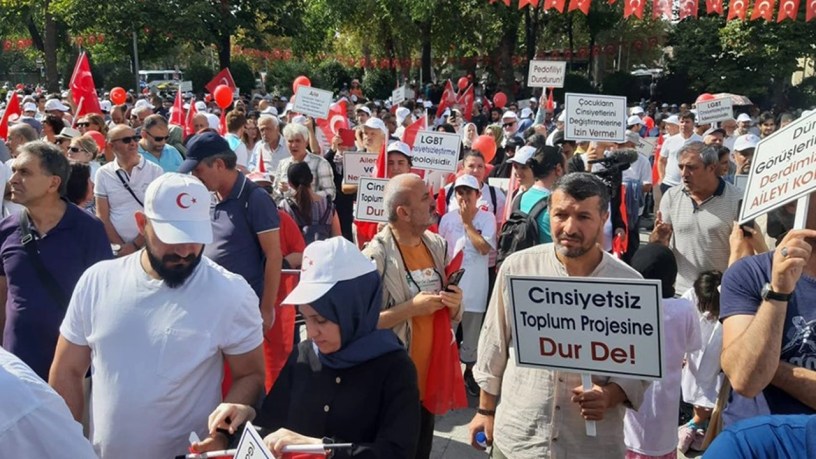
This new actor, which has gained a foothold in Turkey’s public sphere, has been organizing demonstrations for the past two years under the name Büyük Aile Gathering. During the marches, where banners such as “Hands off the children”, “Protect your family against LGBT degeneration”, “Stop the imposition and sociocultural terror” are carried, newly established associations centered on this oppositional movement, columnists from the far-right press and representatives from some right-wing parties such as Yeniden Saadet, HÜDAPAR and Vatan make speeches. We see that the discourses and even the banners used in this local reflection of the global movement are exactly the same as the examples we see around the world: Those who claim that feminism and LGBTI+ advocacy are imported pretend to be unaware of the contradiction created by the fact that their own discourse is used in the same way in many languages and cultures.
Where is the oppositional movement going?
So where is the crisis of neoliberalism, separated by a period of progressive movements, and the counter-movement, fed by the crisis of masculinity, taking the world? The women’s movement, which has been growing stronger and stronger since the last century, even with little public support, faces a male will whose capacity is shrinking day by day. This is causing a disruption in the historical balance of gender roles. As classical male roles such as breadwinner, responsible for his wife and children, and chief economic actor erode, the masculine anger arising from this is directed against women, LGBTI+s, even migrants and lower classes. In recent years, masses of men have reacted to laws and conventions enacted to protect minorities, claiming that they have been victimized and showing that they want to reintegrate with the masculine state. This is evidenced by the demands of the opposition movement in Turkey during the presidential election period to repeal Law No. 6284 and amend the Civil Code. However, despite 20 years of AKP propaganda to the contrary, both the birth rate is falling and the age of marriage is increasing. While legal gains may be under threat in the post-election parliamentary picture, it will obviously not be so easy to eliminate social and intellectual gains. Women, youth, LGBTI+ and other minorities will again have a difficult task: To support popular movements, to participate in them, and to always add their voices to the growing masses.
 morcizgi.org