

Tuğba Sivri
As the centennial anniversary of the Republic of Turkey approaches, it appears that the social issues on the conservative government’s and its political allies’ agenda are gender-based policies such as separate education for boys and girls in schools, potential changes to the Civil Code, and the fight against LGBTI+, as well as sharia. These attempts by those in power to establish themselves in these areas and to sway public opinion in their favor in these discussions indubitably showcase their motives when it comes to the actual direction of the “New Turkey”’s regime, which has been discussed at length for the last 10 years.
In this context, it would be helpful to rethink the republic and reopen the discussion on what the republic promises for certain segments of the society far from economic and political power, such as women, LGBTI+ people, workers, and ethnic or religious minorities. This is mostly due to the fact that the government has been imposing a version of democracy completely confined to majoritarianism for the last 20 years, playing a major role in covering up the real achievements of the republic, including democracy itself. Redefining the republic on its 100th anniversary and re-establishing common values for the society without the constraints of any kind of domination, thus, may be exactly what we need.
If the Majority Wants It, Should We Live under Sharia?
In his article titled “Discussing the republic: A method proposal”, Cenk Saraçoğlu examines the republic as both an idea and a political project and explores whether there are any constants of the republic, looking back from today. He summarizes these constants of the republic, a regime founded on a “sovereignty of the people”, as follows: “Today, to put it in a nutshell, the Republic as an idea consists of notions that sovereignty belongs to the people, that the public interest is superior to all types of private interests, that a binding and restrictive ethical-political framework is essential for social life, that intervention is deemed legitimate to ensure public interest and to prevent domination, and that those who are equal as citizens should also be able to exist as the active political actors.”
These constants indicate that intervention on behalf and in favor of especially women, LGBTI+ people, minorities, and lower classes that intersect the former does not “restrict freedoms of the majority” but, on the contrary, is necessary for establishing the very sense of freedom. Following the same logic, any decision taken based on the majority’s demand for sharia, capital punishment, or, going one step further, pogrom or genocide, would not mean freedom or democracy, but a clear path towards domination. A “binding and restrictive ethical-political framework”, thus, ensures that society remains undivided.
Trying to embody these constants today, it is evident that secularism is one of the essential principles for ensuring public interest. Secularism is vital, especially for lower-middle-class women, children, and LGBTI+ people. The government’s cause for “raising a religious generation”, which started with the 4+4+4 system, continued with the imam hatip (religious vocational schools) process, and finally entrenched with the ÇEDES project (assigning an imam as a “moral guide” for each school), leads to an education system based on gender discrimination, strengthened traditional patriarchy, and clearly alienation of girls from formal education. At this point, it is not difficult to envision that such practices, just like the ban on drinking in public, would impact lower/lower-middle-class girls before anyone else, and that girls who are excluded from education and business would have to deal with grave consequences such as being married off at a young age, domestic exploitation, and violence.
So, where should we look for new codes that underline the necessity of secularism, especially its vitality for women, instead of the proposed cultural codes by the government, which has always defined secularism with an emphasis on its supposed “imposing/despotic” characteristics for many years and thus propagandized anti-secularism to the public? I believe that we must face the fact that these codes must be established for the culture first.
How to Establish the “New” Republic in the Symbolic Field?
One of the expressions that AKP kept repeating throughout its 20 years of political power was “Now that we have established political power, next is cultural power.” Looking back at the attempts to delimit the cultural space in the last few years (ban on concerts, taking aim at certain artists, RTÜK fines, lack of funds, etc.), it is evident that the desired hegemony in this field is only to be achieved through domination. Hegemony is established by manufacturing consent from the public, without the use of physical force, which in turn legitimizes itself. Domination, however, means the use of force, such as the practices listed above.
At this point, the AKP throwing its weight around demonstrates that the party wishes to impress its own cultural and social values upon society, which would, in turn, direct them to a more drastic and radical path, and not that the AKP has failed to establish a cultural “hegemony”. Inasmuch as all kinds of grassroots movements, first and foremost LGBTI+ and feminists, have been deemed “criminal” as an aftermath of the Gezi Resistance in 2013, the young generation seems to already believe them to be so.
We can also assert that a great segment of the public is nostalgic for “former republican values”, and that secularism, one of these old values, is quite important for women, especially lower-class women of Turkey. This very circumstance offers a great opportunity for us to re-establish common social values of a new republic—this time embracing much wider segments of the population. I will now try to crystallize this idea using the example of the Turkey’s national women’s volleyball team.
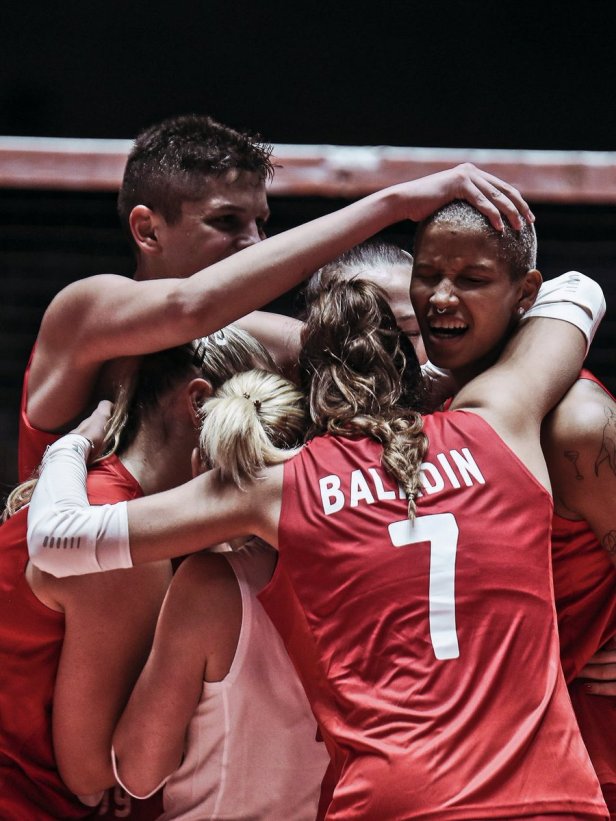
Icons of a new republic: “Sultans of the Net”
“It was revealed recently that girls who showed academic success in a middle school, affiliated with the Ministry of National Education, in Atakum, Samsun were not given a regular certificate of appreciation but a certificate indicating that they are a ‘Daughter of Islam’.” “Amendment to the regulation: Directorate of Religious Affairs is now entitled to organize the education program for children aged 4-6.” “Public announcement from mosque: ‘The Sultans of the Net are infidels’.” The government’s intense religionization policy, as seen in from the news cited above, ultimately targets women and girls in particular and make them face the music. The quoted statement of the mentioned mosque’s imam, who practically calls for a pogrom against the women’s national volleyball team, reveals how aggressive they can be in this culture war.
Such strong reaction to certain issues, however, validates the fact that there is strong resistance to these issues. The resistance mentioned here is in the same line with the one expressed by Michael Ryan and Douglas Kellner in their cult work Camera Politica: “Even conservative films, therefore, can yield socially critical insights, for what they designate in a sort of inverse negative is the presence of forces that make conservative reactions necessary.” These attacks aimed at the national team, especially the hate speech against the two lesbian players, expose the power of the team’s symbolic social meaning—the harsher verbal attacks get, the more their power grows.
What we need to focus on here, in my opinion, is the fact that national team players have now become both a model and a beacon of hope, especially for lower-class girls. “At first they told me, ‘You are a girl: You can’t wear shorts, you can’t play with boys.’ They always excluded me but never the boys. They said, ‘You have a male teacher, he could see certain parts of your body.” These words are from 13-year-old handball player Merve Akpınar, uttered tearfully during an interview. I can attest that, as the national team gained success, this interview went viral on social media once more, and that the team became an example for lower-middle class girls when it comes to participating to social life, just like this young handball player from Urfa. On the one hand, all personal traits of the players, from their clothing to their sexual orientation, were weaponized as a means of humiliation. On the other hand, we see that a strong sense of ownership and the feeling of being a part of society, also fueled by sports’ power to bring people together, are on the rise. This is exactly why I believe that the women’s national volleyball team may be a symbol of the “new republic”.
The women’s national volleyball team, who are on a global winning spree, is shattering a certain symbolic power in a country like Turkey where the only supposedly worthwhile sport is industrial football, dominated by men, and where “women’s sports” such as volleyball are considered insignificant by practically gluing the public to their screens to make them witness one championship after another. They constitute a representation for lower/lower-middle class girls, proving that they can, too, do sports, while also resisting symbolically against Islamist conservatism always meddling with how women dress and behave.
The successful volleyball player Ebrar Karakurt, particularly singled out due to her sexual identity, became an important symbol of this resistance. Karakurt, who doesn’t hide her identity nor back down in the face of queer and women bashing, was very empowering for LGBTI+ people who were exposed to a new attack from the ruling party every day. The openly defiant and unyielding stance of Karakurt, who does not hide her identity nor back down in the face of queer and women bashing, has been quite empowering for LGBTI+ individuals who face new attacks from the government every day. Let’s reiterate: Strong conservative reaction means that the movement that the conservatives resist is just as strong.
Not to be omitted: It is crucial for this new republic to be symbolically established in a way that encompasses the entire society. Revisiting the words of the imam mentioned above, who said, “The Sultans of the Net are infidels,” we see that he has also used derogatory expressions for female football players who wear headscarves. Women with headscarves being more and more visible in the public sphere deeply disturbs Islamist/conservative men. Even though it is the same men who have weaponized and continue to weaponize the archaic ban on headscarves in universities to claim victimization, in reality, women participating in the public sphere with their headscarves threaten their patriarchal privileges. Therefore, women from different backgrounds coming together for any purpose is deemed dangerous for patriarchal power.
Perfect time for a new, egalitarian social contract
As we approach the centennial of the Republic at a moment marked with a genuine regime crisis, the way to break free from all this constriction necessitates a new social contract that safeguards the rights of women, LGBTI+ people, workers, and minorities. It is now necessary to come up with a definition of unity that ensures the essence of being a society, without burdening women with a “national role” or succumbing to nationalist and sexist delusions. Otherwise, the road ahead will still not extend beyond a dichotomy like secularism versus sharia.
The achievements of the women’s volleyball team, the anti-violence stance of certain great female artists, and the products of popular culture where violence against women has become a central narrative point all point to a transformation in the symbolic sphere. It is easy to see the power that this transformation holds just by looking at how violent conservative reactions are. What we need to pay attention to here is to ensure that the new constants to be established in the symbolic level do not exclude anyone, and to prevent arbitrarily sacrificing the already most attacked group, the LGBTI+, in the name of other dominant social groups, by recognizing the power and significance of the LGBTI+ in this symbolic realm.
The intense backlash against Ebrar Karakurt, a member of the national team, for simply existing without denying her identity actually demonstrates why one of the most fundamental slogans of feminist struggle in the past 40 years, “Women/LGBTI+ individuals exist,” is important. Accepting that they exist in the symbolic realm results in empowering them to shape the form and course of this new social contract. If we do not define “public” in a way that includes all the oppressed to ensure “popular sovereignty” free from any form of tyranny, the liberation of neither women, LGBTI+ people, nor any other dissenting community in search of freedom is possible. And in a movement where women are not in the forefront, the fact that secularism is first and foremost a class issue is bound to be overshadowed by a reality created entirely by politicians in power according to “conservative sensibilities”.
 morcizgi.org