

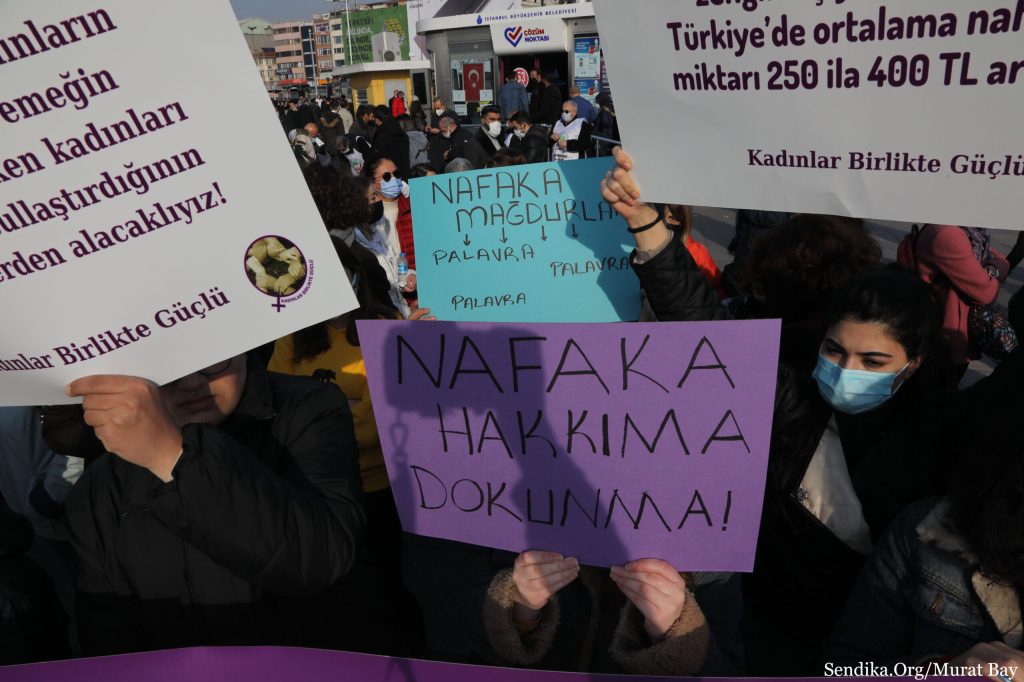
In the first piece of this two-part series, I discussed why alimony is a matter of poverty, what are the facts about alimony in Turkey, which the state refuses to investigate or share despite the insistence of women’s organizations, show us, and why alimony is a “women’s right” despite being “gender-neutral” in the Civil Code. In this piece, I will touch upon women’s realities and experiences of alimony, the fact that the anger of the patriarchal reaction is not limited to the right to alimony, and the state-supported alimony model.
Divorced Women’s Experiences
What do women’s experiences tell us, then? What is the situation of women under the roof of marriage? The marriage stories of the women I interviewed were separate stories of violence. The main thing that led a significant number of them to decide to divorce was that the violence had become intolerable. The majority of the women received death threats after they announced their decision to divorce, and some of them were subjected to violence because of their decision to divorce. The common sentence I heard from almost every woman was “I just wanted a divorce and nothing else”. Therefore, women did not demand alimony, even if they had never worked, either because they were threatened or because they wanted to get divorced as soon as possible, or they were already working during the divorce process. Psychological, sexual and economic violence was dominant among highly educated women. An academic woman explained why she was not subjected to physical violence as follows: “Because physical violence leaves scars. We both existed in an educated environment, so he would resort to forms of violence that did not leave marks on my body.” Throughout their marriage, the two women’s paycards were confiscated by their husbands, and they had no control over how they spent the money they earned. Without exception, all of the women, most of whom had found employment after divorce, had experienced severe physical violence, and many felt compelled to stay in the marriage because of the lack of support from their families and, most importantly, for the sake of their children. Most of these women had never worked in their lives until their divorce, but only one of them was granted 150 TL poverty alimony. The working lives of working women were interrupted due to the burden of domestic labour and childcare. In other words, these women could have been at a much more advanced point in their working lives if they had never married. Moreover, they benefited from services such as paid daycare centers. The biggest problem for women who started working after the divorce was childcare. Most of the women received support from their families or neighbours.
This is precisely where the logic of alimony lies: While a man can benefit from the blessings of marriage and increase his dignity in society, a woman, even if she is working, cannot advance in her working life because she always spends more time on domestic labour and care, and if she is not working, she cannot leave the marriage because the man is in complete control of the money, she has no economic freedom even if she is subjected to violence, and she cannot get support from her family and society. Just because of this inequality, alimony is a “woman’s right” today, even though it is gender-neutral in the law. On top of that, in most cases, the custody of the child is given to the woman, even if she is unemployed (most of the women I interviewed preferred this), so this poverty is not only the poverty of the woman but also the poverty of the child. By the way, let me mention this: In many cases, we see more frequently that alimony no longer refers only to the poverty alimony paid to the impoverished spouse (mostly the woman under Turkish conditions), but also to the maintenance paid to the couple’s joint children. Due to the social shame of refraining from paying an amount that would not even cover one-thousandth of the expenses of one’s child, it is often demanded under the guise of “joint custody”. A female interviewee explained the fact that most men do not see themselves as a partner in the expenses of their children as follows: “When a man divorces his wife, he also divorces his child.” In other words, the child who is not under the roof of the man does not deserve financial support, which is the only form of support he can provide. In everyday life, joint custody means that the woman continues to take care of the child, but the man has a say in every decision regarding the child, and the man can only share in the child’s expenses if he is willing. There are certainly fathers who are equally interested in the care of their children and who care about the welfare of their children, but we know very well that their proportion in the population is very low and we can see this in the data. According to the Mother Child Education Foundation AÇEV’s 2017 study on fatherhood in Turkey, 91 per cent of fathers said that mothers should take care of children between the ages of 0-10. On average, fathers spend 9 hours and 20 minutes at work, 2 hours and 20 minutes with their children and 1 hour and 20 minutes with their friends on a typical working day. In the alimony debates, we should keep in mind that the issue is not only alimony, but also child support.
Attacks on the Civil Code Not Limited to Alimony: Women’s Right to Property Sharing and Compensation in Danger
Objections are also raised to other rights provided by the Civil Code, such as property division or compensation. While the man’s labor, which has a material return, is considered visible and valid, the woman’s labor, which enables that man to advance in his working life, to make his life easier, and to achieve a respected position in society, is both rendered invisible and belittled. Let me illustrate with an example that I frequently come across in interviews and on the internet. You may have come across the expression “The woman who does not complain about bringing tea to her boss at work does not want to bring tea to her husband at home”. Let’s put aside the underestimation of women’s domestic labor (to think that only a cup of tea will bring the house back to life is exactly what someone who has not put the slightest effort into the house would say), no one would find it strange that a man who earns money by cooking would expect his wife to cook for him when he returns home, right? In fact, he considers it his right! This understanding, which sees the man as the “boss” of the house, actually sees the money brought home as an exchange. This is what makes alimony so “victimizing”: The rebellion against not being able to benefit from the woman’s body and labor in return for the money given.
Why is the State Supported Alimony Model Unreliable?
When it comes to women’s rights and freedoms, women have many solid reasons based on experience to distrust the AKP government. However, why we cannot trust the “state-supported alimony model” and on what grounds it can suddenly be abolished, targeted, and become something negative in the eyes of the public, Sevda Karaca[2] [3] has elaborated on this in two mind-opening articles. I will illustrate this with a very recent example.
In 2018, Binali Yıldırım, then Speaker of the Grand National Assembly of Turkey, told the story of an old man. This “victimized” old man complained to Yıldırım as follows: “His wife passed away and he couldn’t get married. He said, ‘You give money to women, no women want to be with us, we, as men, can’t get remarried. Therefore, it would be useful to keep the measure and adjustment of the social state in place.” One of the main arguments of the “victims of alimony” is “We cannot get remarried because of alimony”. According to Binali Yıldırım’s remarks and the steps taken by the government behind closed doors regarding alimony, we can say that the measure of the social state is determined according to the welfare of the man. Women are considered to be the providers of a man and a household for the rest of their lives. Moreover, the widow’s pension mentioned here is such a paltry amount that it seems as if women would not “suffer for any man” if they received three cents, in the words of an interviewee in my research. We also see the issue I mentioned above here: While the majority of men are always ready for second and third marriages, no matter how old they are, whether they are divorced or widowed, women do not want this as long as they have a little economic security and a family to lean on. It is as if for women the family does not seem so “happily ever after”.
Both the Problem and the Solution are Clear: Take Concrete Steps to Lift Women Out of Poverty!
The solution to the alimony issue is very clear: To lift women out of poverty. This is a very large-scale project. It requires teaching equality between men and women in schools, creating employment opportunities for women, providing free child, elderly and disabled care services as much more urgent measures. Neither the state nor traditional family men want to abandon women to their fate; on the contrary, they want to make full use of their bodies and labor. All these efforts to keep women in marriage are a strong indication of this. If the claims in these debates were sincere (for example, there are groups that say they want women to be self-sufficient individuals), the idea of a woman as an “individual” would not come to mind after divorce. Even if a woman works within the marriage, she would not be seen as the main responsible for domestic service and care. While their roles as mothers, wives and caregivers were glorified, working, independent, childless, single, divorced women were not openly condemned. If the state is going to allocate a budget, it should not be spent on paying alimony to women like “handouts”, but on taking steps to help women gain their independence. The basic needs of divorced or divorcing women are common and clear: Free childcare, health care, priority in employment, housing, vocational training. There is nothing wrong with the genderless and egalitarian article of the law; it is the sexism and inequality in daily life that urgently needs to be addressed. Amending the article of the Civil Code without taking any steps to combat this inequality means securing male domination over women with the law and deepening the existing inequality.
 morcizgi.org